


If you ask ten founders what corporate venture capital is, you’ll probably get ten different answers.
Some think CVCs are just traditional VCs backed by large corporations. Others assume every corporate investor is looking to acquire them or become a customer. The reality is far more nuanced.
In many ways, “CVC” has become like “family office.” It’s a catch-all label that groups together investors with very different structures, incentives, and ways of operating. The label tells you who the investor is. It doesn’t tell you how they’ll invest.
That’s exactly where most of the confusion starts.
What is CVC?
At the highest level, corporate venture capital is an investment arm or dedicated fund set up by a corporation to invest in external startups. Unlike traditional venture capital firms, which invest on behalf of outside limited partners (LPs), CVCs invest capital from a corporate parent.
At first glance, CVCs can look a lot like traditional venture capital firms. They source deals, conduct diligence, invest in startups, join boards, and support portfolio companies. But beneath the surface, they often operate under a different set of incentives, which shapes everything from how they evaluate opportunities to how they define success.
While CVCs have been around for decades, they've become an increasingly important part of the venture ecosystem. Today, corporate investors participate in nearly one in four venture deals, and more than 3,000 corporations invested in startups in 2025 alone. From healthcare and financial services to manufacturing and enterprise software, corporations are using venture investing to stay closer to the technologies and business models shaping their industries.
Why Do Corporations Invest in Startups?
One of the biggest misconceptions about corporate venture capital is that it’s simply an acquisition pipeline.
In reality, most large companies think about innovation through multiple levers. Depending on the opportunity, they may choose to build a solution internally, buy a company, partner with a startup, or invest in one. Each option serves a different purpose and comes with different levels of commitment, risk, and control.
Unlike an acquisition, a venture investment allows a corporation to learn from and work alongside a startup without fully integrating it into the business. That flexibility is one of the reasons CVC has become an increasingly important part of many corporate innovation strategies.
Just as importantly, not every CVC is optimizing for the same outcome. While traditional venture capital firms are primarily measured by the financial returns they generate for their limited partners, corporate venture capital programs often fall on a spectrum of strategic and financial objectives.
Here are some of the most common reasons corporations invest in startups:
Staying Close to Innovation
For many corporations, venture investing is a way to see where an industry is heading before those trends become obvious.
By building relationships with startups working on emerging technologies or business models, companies gain early visibility into shifts that could reshape their markets. These insights can influence product roadmaps, internal strategy, or future investment decisions.
Example: GV invests across AI, life sciences, enterprise software, climate, and frontier technologies, giving Alphabet early visibility into emerging innovations and entrepreneurs shaping the future, even when those companies have no immediate connection to Google's existing products.
Hedging Against Disruption
Sometimes the greatest risk to a corporation isn’t missing the next big opportunity, it’s being disrupted by it.
Rather than making a large acquisition or overhauling its core business too early, a corporation can invest in startups that are challenging existing ways of doing things. This provides a lower-risk way to learn, monitor market adoption, and build relationships while waiting for stronger evidence that a new technology or business model is gaining traction.
Example: Intel Capital has historically invested across emerging semiconductor, infrastructure, AI, and computing technologies, allowing Intel to stay close to innovations that could reshape the broader computing ecosystem without committing to a full acquisition or major product strategy shift.
Exploring New Markets and Business Lines
Corporate venture capital can also help companies explore opportunities beyond their existing products or customers.
Rather than building an entirely new business from scratch or acquiring an unfamiliar company outright, corporations can invest in startups operating in adjacent markets to better understand customer needs, competitive dynamics, and long-term growth opportunities.
These investments often provide strategic insight into markets the corporation may eventually choose to enter, whether through partnerships, acquisitions, or internal product development.
Example: Qualcomm Ventures invests not only in technologies that support Qualcomm's core semiconductor business, but also in adjacent areas like automotive, AI, IoT, enterprise software, and digital health to explore where future growth opportunities may emerge.
Creating Commercial Opportunities
An investment can also be the beginning of a broader business relationship.
Portfolio companies may become customers, suppliers, technology partners, or distribution partners. In many cases, the value of a successful commercial partnership can far exceed the financial return from the investment itself.
Example: The Cigna Group Ventures invests in companies that can improve healthcare delivery and has helped portfolio companies (e.g., MDLIVE, Omada, and Headspace) develop commercial relationships across The Cigna Group and Evernorth.
Creating Strategic Optionality
Investing gives corporations a front-row seat to a startup’s progress without requiring the commitment of an acquisition.
Rather than buying a company before the technology or market has fully matured, a corporation can build a relationship, monitor execution, and better understand how the business evolves. While some portfolio companies are eventually acquired, many are not. The investment simply preserves optionality as the market develops.
Example: Salesforce Ventures invests broadly across the enterprise software ecosystem, creating relationships with companies that often become technology partners, AppExchange integrations, or strategic collaborators. The goal is to create dependency and stickiness to Salesforce’s software platform.
Generating Financial Returns
Not every CVC is primarily driven by strategy. Some are expected to generate competitive venture returns alongside, or even ahead of, strategic outcomes.
These organizations often resemble traditional venture firms, with dedicated investment professionals, disciplined portfolio construction, and return expectations comparable to institutional VC funds.
Example: MassMutual Ventures explicitly invests with the objective of generating top-tier venture returns while strategically investing in innovations that complement the insurer's core businesses.
The key takeaway is that there isn't a single reason corporations invest in startups. Every CVC balances strategic and financial objectives differently, and those priorities shape everything from how the investment team is structured to how it behaves as an investor. Understanding those motivations is often just as important as understanding the sectors a CVC invests in.
Recommended for you:

Not All CVCs Are Structured the Same
One of the biggest misconceptions of corporate venture capital is that every CVC operates the same way. In reality, there are a few different ways corporations can structure their investment programs.
The first distinction is where the investment capital comes from.
Some CVCs invest directly from the parent company’s balance sheet. In this model, there isn’t a separate venture fund. Instead, each investment is funded with corporate capital as it’s approved. This has historically been the most common approach, particularly among large public companies.
Other CVCs operate with dedicated committed capital. The parent company allocates a specific amount of money, such as a $50 million venture program, that’s reserved exclusively for venture investing. While the capital still comes from the corporation, it’s ring-fenced for the investment team to deploy.
The second distinction is how the investments are held.
Some corporations invest directly, meaning the parent company owns the startup shares itself. Others create a separate legal investment vehicle, such as an LLC or limited partnership, to make and hold investments. This gives the venture team greater operational independence and dedicated governance. Although these entities are legally separate, they are often still consolidated into the parent company's financial statements, which is why the term "off-balance sheet" isn't always technically accurate.
Finally, there’s how long the capital is intended to last.
Many CVC programs are evergreen, meaning they don’t have a predetermined end date. The corporation can continue funding new investments over time and may recycle proceeds from successful exits back into the program.
Less commonly, a corporation will establish a closed-end fund that looks much more like a traditional VC fund, with a fixed pool of capital, a defined investment period, and a target lifespan of around ten years.
Three Questions That Define a CVC
Not all corporate venture capital programs are built the same. Understanding how a CVC is structured can tell you a lot about how it makes investment decisions, how flexible it is, and what kind of partner it may be after writing a check.
Every CVC can be understood by answering three questions:
These three questions won't tell you whether a CVC is the right investor for your company, but they will give you a clearer picture of how the investment team operates, how resilient the program may be through changes in corporate strategy, and what you can reasonably expect from them as a long-term partner.
Lastly, there are a few edge case structures worth noting.
Multi-corporate funds
Some venture funds are backed by multiple corporations at once. This spreads risk and reduces dependence on a single corporate sponsor, which can make the structure more stable in certain situations.
Example: Sony Innovation Fund has participated in consortium-style investing alongside other strategic corporations, a structure that shows up most often in sectors like media, telecom, and industrial technology where shared access to innovation matters.
Externally managed CVCs
In this model, the corporation provides the capital, but an outside VC firm runs the investment process. It can give the program more institutional investing experience while still keeping a strategic lens from the corporate side.
Example: Cerity Partners Ventures manages capital on behalf of corporate and strategic partners, separating investment execution from the corporation’s internal operating team while still aligning to strategic objectives.
Evergreen funds with outside LPs
Less common, but some corporate-sponsored vehicles blend capital from both the corporation and external limited partners. These structures sit somewhere between traditional VC funds and pure corporate venture programs, often to scale capital or broaden alignment.
The CVC Behavior Matrix
The biggest mistake I see founders make with CVCs isn’t taking corporate money. It’s assuming all corporate investors are playing the same game.
Some CVCs behave almost exactly like traditional VCs. Others are deeply embedded in the business and can help open commercial doors. Others are primarily there to learn, monitor markets, or explore technologies that could shape the future of their industry.
The problem is that “CVC” tells you who the investor is, not what they’re optimizing for.
That’s why founders often walk away disappointed. They assume every corporate investor can unlock customers or accelerate commercial partnerships, when in reality many were never investing for those outcomes in the first place.
That’s why I created the following framework. Instead of asking whether a CVC is “strategic,” it helps answer a much more useful question:
What is this CVC actually optimizing for?
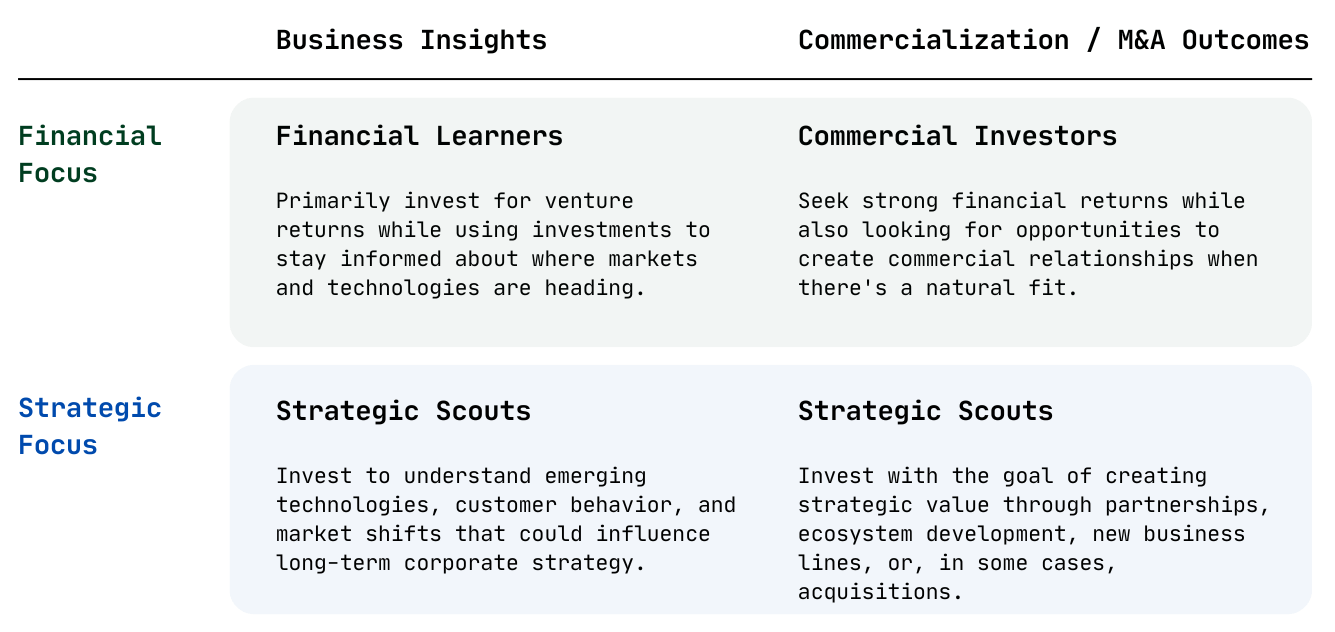
The CVC Behavior Matrix
X-axis: Financial Focus → Strategic Focus
Y-axis: Business Insights → Commercialization / M&A Outcomes
This isn’t a framework for how a CVC is structured. It’s a framework for how it’s likely to behave after making an investment.
How to Use This Framework
No CVC fits perfectly into one quadrant. Priorities evolve over time, leadership changes, and individual investments may serve different purposes than the overall fund strategy.
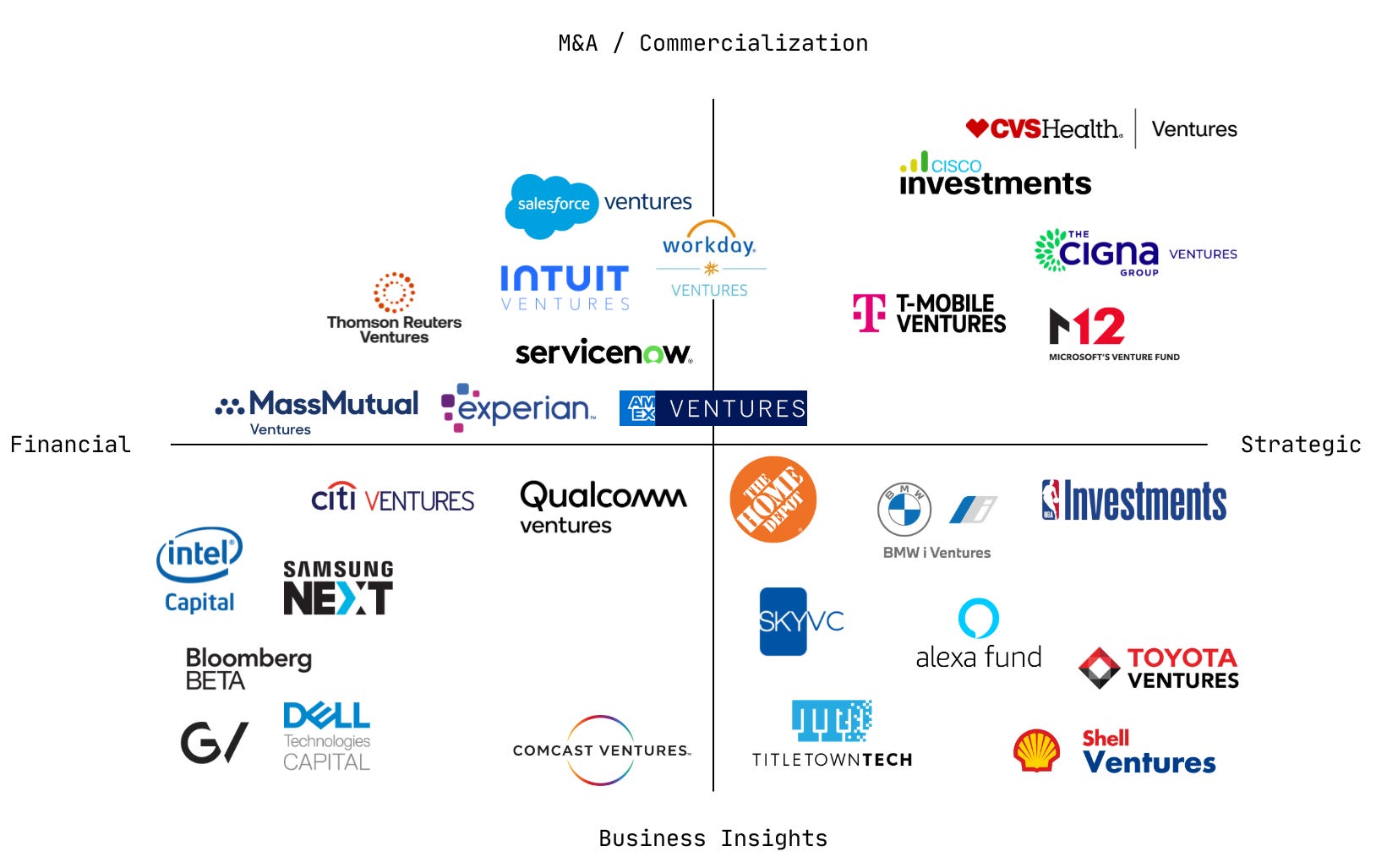
The point isn’t to label every CVC. It’s to understand what success looks like for the investor sitting across the table.
If a CVC sits closer to the Financial end of the spectrum, you should generally expect it to behave more like a traditional venture investor, where financial returns drive decision-making.
If it leans more Strategic, it’s more likely to evaluate opportunities based on how they can create value for the broader business, whether through learning, partnerships, new business lines, or long-term strategic positioning.
The vertical axis tells you what that strategic value actually looks like.
Some CVCs invest primarily to generate business insights. They’re looking to understand emerging technologies, customer behavior, and where their industry is headed. Others are investing to create commercialization or M&A outcomes, where success is more closely tied to commercial partnerships, product integration, or, in some cases, acquisitions.
Four Questions to Ask Every CVC
Once you understand the framework, the next step is figuring out where a specific CVC falls.
These are four questions I always recommend asking before taking corporate capital:
What percentage of your portfolio companies have become commercial partners with the parent company?
Do you require a business unit champion before making an investment? If not, how do you help portfolio companies navigate internal business units after the investment?
How often do startup pilots convert into annual commercial contracts?
How does your investment team measure success internally?
The answers to these questions will often tell you far more than the CVC’s website or investment thesis.
Why This Matters
One of the biggest misconceptions founders have is that taking money from a corporate investor automatically opens the door to enterprise customers.
That’s rarely how it works.
Even the most strategically motivated CVCs usually can’t force a business unit to buy your product. Commercial introductions can absolutely happen, but they’re still subject to procurement processes, internal priorities, budgets, and executive buy-in. A warm introduction is valuable, but it isn’t the same as a signed commercial agreement.
The opposite misconception is that every corporate investor is looking to steal your technology or quietly acquire your company. While acquisitions certainly happen, they’re far from the default outcome.
Take a Kubernetes security company, for example. Its value comes from becoming the trusted security platform across cloud providers and enterprises of every size. That business is often worth far more as an independent platform than as a product owned by a single corporation. A CVC can still generate significant strategic value through market insight, partnerships, and financial upside without ever intending to acquire the company.
The takeaway is simple: don’t evaluate a CVC by its brand alone.
Instead, evaluate:
How the investment team is measured?
Who sits on the investment committee?
Whether business units actively engage with portfolio companies?
How many commercial wins they’ve actually produced?
What success looks like inside the organization?
Those answers will give you a much more realistic picture of the partner you’re bringing onto your cap table than the word “strategic” ever will.
Solid. Thank you!