


Startup and tech events tend to happen in the same places.
Coffee shops, event spaces, open-plan offices with tastefully understated Knoll furniture that belies how much a large pension fund this startup paid for it.
Not ours.
Let me preface this by saying we are very appreciative of Reitler for letting us use their space. (Thanks, Theo!)
With that out of the way, it’s time for me to say this out loud.
Founders & Fractionals is held in an objectively ridiculous room.
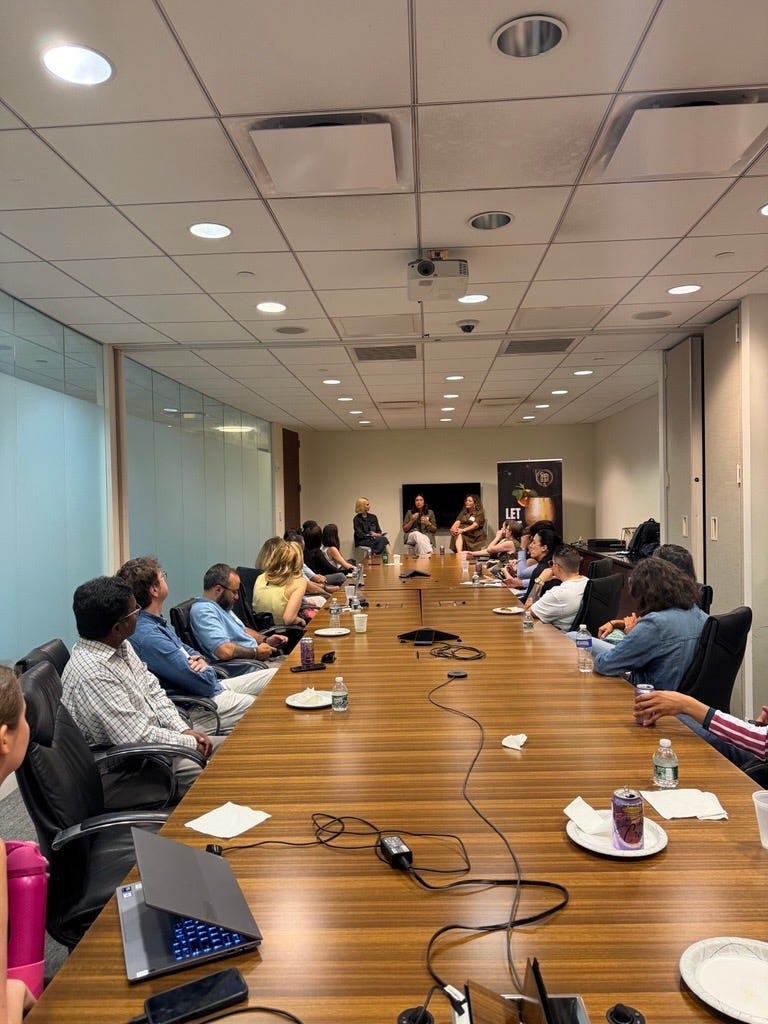
It is a straight-up boardroom. Thirty-plus chairs around one long, narrow table. Great for hostile takeovers and the like. Not so great for networking. Definitely doesn’t scream early-stage startup event.
People walk in and there is usually a beat of confusion.
Am I in the right room?
Am I walking into someone’s deposition?
Am I walking into my own??
Eventually people find their seats, chat with whoever ended up next to them, and the panel gets going. Pretty normal stuff from there.
The magic happens when we open up for Q&A. People just react differently at that moment. For some people, there’s still tension. They’re looking over at Maddi or I before they jump in. It’s a bit of: are we doing hand-raising , are we taking turns, like what’s the format here?
But for others you can see a spark, a twinkle, a something that says showtime!
Yeah, so we’ve tried this several times and here’s where it broke…
Real disagreement. Unapologetic viewpoints. People get sharper and speak up. They stand up to hand-wavy suggestions, question fluffy rationale, but none of it is combative or mean. It’s just a level of comfort with saying stuff.
Recommended for you:

I think the phenomenon is amplified by how much start-up culture can be almost comically different. There is a lot of improv and a lot of “yes, and.” That is probably necessary when everybody is trying to make something out of nothing, but it can also create this weird social pressure where every contribution has to be additive and every idea gets treated like it might secretly be amazing.
Sometimes you end up with a room full of people politely building on an idea nobody actually believes.
Meanwhile, in corporate America, people learn pretty quickly that “yes, and” turns into a meeting.
Then another.
And then another but to bring additional stakeholders up to speed.
Which means dashboards.
And decks. And trackers. And trackers tracking trackers.
You get the point. Yes, and is a rookie mistake that no one makes twice. That’s why we learn corporate’s incredible defensive vocabulary.
Take it offline.
I’ll ping you separately.
I’ll circle back.
I’m convinced let’s put a pin in it has resulted in more corporate productivity than Microsoft Teams ever will. It’s an artform. It’s also incredibly irritating and I think it’s probably half of why many of us left corporate to do our own thing.
A pathological aversion to new is so incompatible with startups and the people who operate in and around them. But it is extremely funny to watch those instincts reappear the second you put people back around a boardroom table.
You would think everyone would get up and move somewhere more conducive to meeting people.
They don’t. They stay for another hour.
Networking.
Around a table where the person you want to meet might be four chairs away and therefore approximately 70 feet from you.
Somehow it works.