


Sorry for the radio silence. I’ve been vibe coding a lot recently. And by that I mean actually mostly fundraising.
But I have been thinking a lot about how much fun so many people I know are having with Claude Code.
For me, finally being able to code has been a huge personal victory. The losing streak goes back decades.
My dad got me a copy of Interplay’s Learn to Program BASIC, which lived perpetually in the CD-ROM drive of our Macintosh Performa. That will tell you how long ago this was.
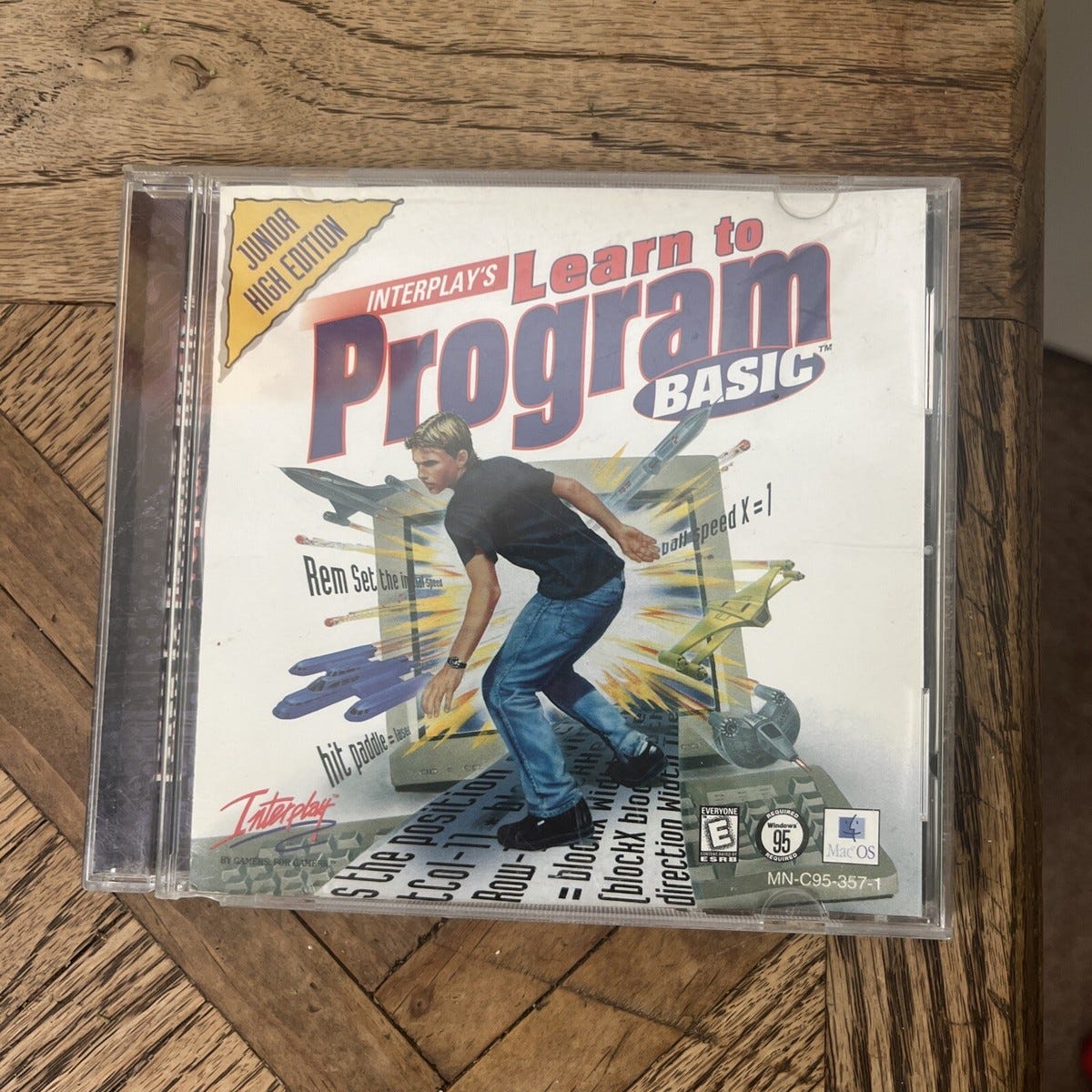
It came in a box with a workbook, a reference card, and an animated guide named “Media Man” who walked you through coding puzzles on a screen that looked like a game. I did every lesson. I had fun. Then the tutorial ended, the blank editor opened, and I realized I had not learned anything transferable to the blank screen.
The same company made another CD-ROM called Chess Mates. I played that one religiously too. When I finished the puzzles and faced the blank board, I felt like I knew what to do.
The game had boundaries. The pieces had rules. The tutorial compressed into instinct and I was ready to play. Coding was different. The blank editor had no boundaries, no rules I could feel, no compression. The puzzles were solvable. The editor was not. I closed it and did not open it again.
Coding fail #1.
Back to Chess Mates.1
I tried my hand at coding again in the MySpace era because I needed a lime green background and Weezer on autoplay alongside a hand-edited-to-look-like-Abercrombie picture badly enough to spend an entire weekend copying and pasting HTML I did not understand. It kinda worked until it didn’t.
Fail #1.5, but we can round up to Fail #2 if we include the hand-edited picture.2
Then I went to Wall Street, where I discovered that financial modeling is what happens when you give people who wanted to feel like programmers a spreadsheet and a sense of purpose. INDEX MATCH felt like coding.
It was not. It was arithmetic in Midtown, with bit loafers, while "plugged in."
But it felt like it. And, weirdly, that kinda mattered.
I think it mattered because, by that point, software had become the nearest thing the economy had to a control panel. To be close to code was to be close to leverage, scale, modernity, the future itself. Even the people who were not building software wanted some diluted version of the feeling. We wanted to believe we were talking directly to the machine instead of filling out forms for somebody else’s system.
The desire was constant. The chasm in between was constant too.
And over time the chasm acquired weight because the ability to cross was finally, truly meritocratic.
All it took was three simple words:
"Learn to code."
It stopped being a technical barrier and became a theory of the world:
This is where the leverage is.
This is where the middle class lives now.
This is the bedrock of the modern economy.
This is the in-group: the people who could speak to machines in the language machines required.
Outside were the people who needed translators. If you were on the wrong side, the answer was never that the interface was wrong. The answer was that you should have or could have worked harder. And if you are not on this side of it, that is a fact about your position, not an opinion about your character.
Open Sesame
To the people trying to get in, it was a shibboleth. Say it right, you pass.
Get the credential, learn the syntax, prove you belong.
Tech blogger, founder, thinker Paul Ford wrote 28,000 words in Bloomberg explaining the entire world of code to the people locked out of it. That is the most generous pronunciation guide ever written for people standing at the river crossing. It was also, by definition, a document about a border.
Hakuna Matata.
To the people inside tech, it was a way of life. The water they swam in. Code is how you think, how you build, how you matter. It was not advice because it was not optional. It was identity.
A philosophy so native to the people living inside it that they could not hear how it sounded from the outside.
Try hard and believe in yourself.
To the taxi drivers, the journalists, the factory workers, the travel agents, and everyone else whose industry got optimized out from under them, it was a platitude.
It had the weight of a correct diagnosis, which is heavier than a sermon, because you can argue with a sermon. You cannot argue with someone who is demonstrably doing fine.
That is what makes the current moment so disorienting. That was the software social contract for a long time. We told taxi drivers, journalists, designers, factory workers, middle managers, everyone: the future is coming, and if you want agency in it, learn the syntax. Learn the abstractions. Learn to think like the machine.
After all, there was a certain pragmatism to it:
Software was eating the world. Better to be at the table than on the menu.
It was not wrong when they said it.
It just stopped being true.
A lesser version of this essay would stop there and enjoy the irony. It wouldn’t hesitate to say something irritating like:
“ain’t so funny when the rabbit’s got the gun”
-or-
“you die a disruptor or live long enough to become the disrupted”
That would be sharable. It would be ragebait-y. It would also be pointless.
Disruption is a feature, not a bug, and I’m much more interested in what happens next.
I feel like it gets lost now that Silicon Valley is so corporate and mainstream, but the founding energy there was all about refusal. It was people looking at the permission structure of the twentieth century and deciding to route around it. You didn’t bother asking ‘Big Blue’ if computing could become personal. You never cared what ‘Ma Bell’ thought about networks belonging to everyone.
The whole point of the rebellion was that the permission-holder did not get a vote. Build it in a garage. Ship it anyway. Conviction first, permission never.
Or as a wise man once said: “I’m the CEO, bitch” “Move fast and break things.”
And they did.
Builders built incredible companies. But, eventually, rebellion becomes the thing it seeks to destroy. It develops institutions and credentials and rules. They start dictating permissions like who gets to build software. Who gets to translate a human problem into a machine solution. Who gets to charge rent on the distance between “I know what I need” and “I can make a computer do it.”
Coding was genuinely hard and the gate got to survive by calling itself talent. Because it was. I certainly couldn’t do it. See me vs. BASIC.
That is why the current moment feels so charged.
What Claude Code represents is not just a better developer tool. The garage energy is back. But this time, the V1 gang is IBM.
As I am wont to do, I usually take a look backward to help make sense of things.
Rewind the clock to 1894.
The local general store did not merely sell goods. It controlled legibility. It decided what was available, at what price, in what sequence, with what humiliation attached. The farmer was not poor in some abstract way. He was informationally trapped. He often did not know what a plow, a stove, a shirt, or a guitar should cost in a wider market. The storekeeper monetized that opacity.
Sears changed that by publishing their catalog.
The catalog did not do anything mystical. It just arrived in places the retail system had treated as captive territory and printed the price list in public.
Basically instructing you to compare prices and see the markup for yourself. The disruption was made literal: not a store, but a published list of what things cost, delivered to people the system had decided did not need to see the numbers.
It’s just basic market dynamics at the end of the day. That is what the best technology does. It does not merely lower cost. It makes hidden things legible.
The interesting part was the moral vocabulary that grew up around them. The catalog was going to destroy communities. It was going to hollow out main streets. It was going to sever the relationships between neighbors that made small-town commerce personal and trustworthy. Money would leave town and never come back. The backlash tells you what was really being threatened.
If any of this sounds familiar, it should.
There has been a lot of chatter about prediction markets recently. The argument gets framed as gambling versus journalism, or speculation versus responsibility. But listen to the actual objections and you will hear the same structure underneath. The information is unreliable. The source is illegitimate. The community, whether that means democracy or public trust or market integrity, will be harmed. Prediction markets publish a number on uncertainty before the recognized authorities have finished deciding who is allowed to name it.
They take things that once lived in the hands of gatekeepers, like election odds, recession odds, and policy odds, and make them public, liquid, and embarrassingly legible.
Prediction markets do not need insider trading to make people uneasy. They only need a world in which public information is legible to a few and invisible to everyone else. From a distance, that can look like cheating. What feels suspect is often just the discomfort of discovering that someone else can read signals you cannot.3
The outrage is not only that the market might be wrong. The outrage is that the wrong people are making uncertainty visible without first asking permission from the old permission-holders.
Claude Code is doing the same thing in a different register.
It makes the translation between intent and execution legible to people who were previously locked out of it. The person who hated Salesforce did not lack desire. They did not lack domain knowledge. They did not even lack precision. They lacked a way to express what they meant in the format the machine would accept. That gap looked like a skill deficit because the software industry built a business around keeping the translation layer expensive. Claude Code publishes the price list.
That is the deeper reason the moment feels rebellious. It is not just that the tool is powerful. It is that it routes around a permission structure the software world spent decades normalizing. The old deal said: if you want agency, come live with us in the abstractions. Learn the syntax, the stack, the rituals, the version control, the whole liturgy. The new deal says: tell me what you want, and we will negotiate from there.
Paul Ford has the cleanest instinct for what technology is supposed to do. On an episode of The Vergecast last week he said something that really stuck with me:
“When you use the computer to multiply things and make them cheaper, that feels very computer to me. But when you use the computer to make things expensive, that’s not computer.”
That is the whole test.
The technologies that matter are the ones that dissolve toll booths. They strip opacity out of a system. They reveal the hidden markup. They widen access to the underlying capability.
Sears did it for prices.
Prediction markets do it for uncertainty.
Claude Code does it for software.
The panic starts when unauthorized legibility shows up inside a system built to keep the numbers hidden.
It takes conviction to blow open a permission structure, and a certain innocence not to feel the full cost. For thirty years, the tech industry had that innocence. It displaced other workers while remaining strangely insulated from the feeling of displacement itself.
Builders knew how to route around institutions. They did not know, in their bodies, what it felt like when their own format stopped being recognized. They could describe the problem. They could build products for it. But they did not have the one piece of information that matters most when a system stops mapping cleanly onto the world: the texture of the break.
Now they do.
The people being told that their hard-won syntax is less scarce than they thought are acquiring a new kind of knowledge.
Not moral superiority. More like a map. They know which parts of the old credential stack still matter and which were mostly payment for access. They know where the shame collects. They know which workflows still assume obsolete permissions. They know what it feels like to discover that the thing you spent years mastering has shifted, suddenly but naturally, from gate to substrate.
That is the part most people will miss in the current panic. They will treat this moment as pure injury, and sometimes it will be. But some small number of people will treat it as signal. They will look at the places where they themselves felt locked out, oversold, mistranslated, humiliated, and they will build the adapters that make those failures legible for everyone else.
The valuable skill now is not merely technical fluency. It is the ability to recognize a permission structure as a permission structure, even after it has disguised itself as meritocracy, professionalism, or good advice.
The pattern is old. The only new thing is where it has landed.
And the empathy it creates among the next generation of founders offers an intriguing paradox: AI just might usher in a more human era in technology.
Mount Rushmore of my favorite 90s edutainment games:
- Putt Putt Travels Through Time
- Math Blaster
- Super Munchers
- Chess Mates
The picture:

The “insider-trading” argument about recent prescient bets on prediction platforms has really irritated me. Not every edge that looks illicit is illicit. Sometimes it is just operational literacy. Or fluency in something most people only encounter as an abstraction. I’ll likely write about this is more depth later.
I like the article overall. But I cannot bring myself to agree with the prediction market insider trading.
Are you saying it is fair and useful to society that people with military knowledge bet on such outcomes?
Or people in government using their insider knowledge?
Sure this happened before but at least there were less outlets where that information could be monetized.
To me this is the same argument as with crypto: sure ransom was a thing before but crypto made it very easy. And is THE use case a layman can see for crypto that could not be achieved with regular money.