


Last week was a big week for takes. A Jefferies analyst gifted the internet ‘SaaSpocalypse,’ and the timeline did what the timeline does.
SaaS was simultaneously dead and invincible. Vibe coders were coming for everything. No, wait, enterprise moats had never been deeper. Lots of opinions on both sides.
So there I am, scrolling LinkedIn dot com perusing the discourse when a reply stopped me cold. Not even a post. A reply to a post.
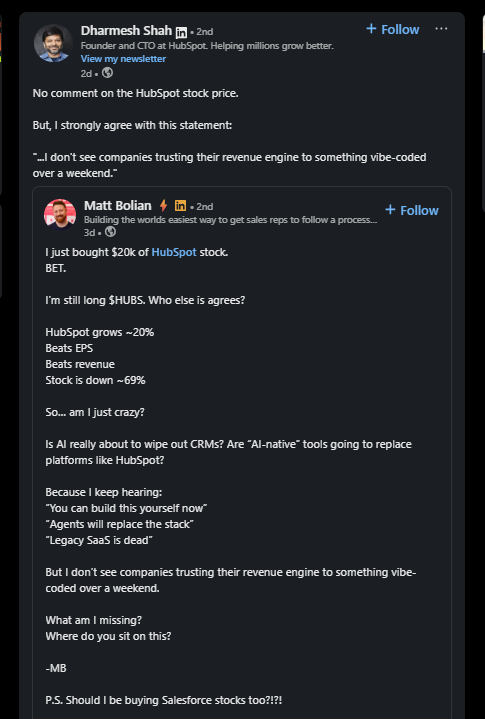
I didn’t stop for the stock advice and I didn’t stop to jump in the fray.
I stopped because the reply apparently tickled something deep in my lizard brain and something bizarre came flying out of the archives:
“Five hundred dollars? Fully subsidized? With a plan?
That is the most expensive phone in the world.
And it doesn’t appeal to business customers because it doesn’t have a keyboard.”

“I don’t see companies trusting their revenue engine to something vibe-coded over a weekend.”
“It doesn’t appeal to business customers because it doesn’t have a keyboard.”
The confidence in both those statements response rhymed to me. Not in deck-chairs-on-the-Titanic way, though.
Brains are weird. I needed to investigate. I had a feeling it might be because we’d just fired our expensive CRM and the world didn’t fall apart. But then I started thinking more about the way that I actually use “AI.
The translation layer
I wrote more about it here, but I experience AI as fundamental shift in the way I work with my computer. Specifically, how I get to interact with my own information on my own terms. I think this is why the connection to the iPhone moment leapt out.
The iPhone’s touchscreen collapsed the abstraction layer between intent and action. Before it, you had to translate what you wanted into the system’s language: stylus taps, button presses, menu navigation. The touchscreen let you just touch the thing itself. Pinch to zoom. Swipe to move. The interface disappeared, and you interacted with the content directly.
AI does the same thing for information. Before, you had to conform to the system’s retrieval logic: craft the right Google query, learn SQL, navigate folder hierarchies, read entire documents to extract what you needed, learn a software’s menu structure. AI lets you just say what you want in your own words and get back something shaped to your context.
The core parallel is the same: both eliminated the translation step between human intent and system response. The iPhone made the hand the interface. AI makes natural language the interface.
Team keyboard wasn’t wrong back then.
At that point, most consumer touchscreens really sucked. I don’t even remember where I encountered touchscreens in 2006, but the handful I did interact with were absolutely awful.
In the iPhone launch keynote, when Steve Jobs demoed slide to unlock and flick to scroll, the audience reacted like he was performing a magic trick. The technology he was showing them was genuinely discontinuous from every touchscreen they’d used before.
The thought that you’d trust your ability to make emergency calls to a touch screen without a safety fallback was crazy.
Touch screens were by no means perfect. They still aren’t. Autocorrect, swipe-to-type, machine learning, etc. have all helped. They can still be pretty ducking annoying.
Still didn’t save the keyboard.
When defaults become doctrine
More abstractly, it’s a shifting of constraint. Through that lens, there’s a pattern that emerges between incumbents and challengers which might explain the “tribal” energy of the SaaSpocalypse.
I remember thinking RIM’s evangelizing about the value of the keyboard was bizarre as a rather disgruntled owner of a Blackberry Pearl. Before the iPhone existed, RIM was actively minimizing the keyboard to make room for a larger screen and media features. The iPod Shuffle of Blackberry products.
By 2008, the BlackBerry Storm, their touchscreen answer to the iPhone, had flopped. Lazaridis responded by announcing “4 core pillars” for the company. One of them was “Keyboard.”
The thing they’d been shrinking 12 months earlier was now a core pillar. Tactile feedback became a religion.
When the constraint moves, incumbents don’t just defend market share. They defend the interface. They take the thing that used to be a delivery mechanism and recast it as a moral position.
Before the threat, you sell outcomes. After the threat, you sell the container.
That’s what the keyboard pivot was. Not “keyboards are good.”
More like:
Keyboards are serious.
Keyboards are safe.
Keyboards are for professionals.
Keyboards are what adults use.
Keyboards appeal to enterprise customers.
You can hear the same cadence in SaaSpocalypse land if you listen for it.
The version we keep hearing is: these models don’t have the infrastructure to hold enterprise data. Without scale, they can’t enforce data sovereignty. Your information isn’t safe in a system that wasn’t built to persist it.
These are the same companies that have been holding our data inside proprietary schemas for a decade. The same ones that fought interoperability, locked exports behind enterprise tiers, and treated our workflow as a retention mechanism. They didn’t build data sovereignty for us. They built it around us.
And now they’re worried someone else might not take good enough care of our data?
What’s really being defended here isn’t our data. It’s their position as the system that gets to intermediate it.
Dan Ives put it plainly: “The new AI players don’t have the capacity to hold all enterprise data and protect organizational structures from malware.”
He meant it as a warning. But read it again.
You can’t breach a system that doesn’t retain. You can’t leak a database that doesn’t exist. Pipes that don’t hold water don’t spill.
Non-persistence isn’t the vulnerability. It might be the architecture.
It’s also why it rhymes with RIM. A default turns into doctrine the moment it’s threatened.
The dashboard becomes a virtue, not a constraint. The fact that you can see every button becomes “control.” The fact that you have to learn the menu becomes “governance.” The translation step becomes a feature.
And that’s where my own little CRM incident matters, because it forced me to stare straight at the translation layer.
Windows to your data
We had a CRM because that’s what serious people do. It was just how you operate. I told myself we were paying for “workflow” and “insights” and “process.”
Then one day I exported the data.
Contacts. Notes. Relationship edges. Deal history. All of it came out in a couple of files that looked exactly like what I’d expect: our stuff, in columns.
The product wasn’t the data. The product was the way the data was presented back to me.
The arrangement. The default views. The blessed workflow. The feeling that I was “running a system” instead of looking at my own notes.
So I did the unglamorous test. I turned it off.
Nothing caught fire, because in our case the CRM wasn’t the source of truth. It was the view layer.
In companies where the CRM is wired into comp, compliance, routing, and reporting, the fire is real. But that clarifies the point: the rent lives in how hard it is to replace the interface and its governance, not in the raw storage of your contacts.
For a whole class of software, UI/UX is the margin.
The constraint moved
The iPhone didn’t make keyboards bad. It made the screen a general-purpose surface. Once the surface could be redefined by software, the keyboard wasn’t “wrong.” It was just no longer the bottleneck.
AI is doing something similar, but the mechanism matters.
The threat isn’t “someone builds a better Salesforce in a weekend.” That’s a strawman, and it’s easy to dunk on. Enterprise software is complex for real reasons. The threat is that the cost of building, iterating, and personalizing an interface is collapsing.
Not typing “build me some SaaS” into a magic chat box. More like, the dashboard stops being a product you rent and becomes a view you generate from your own data and valuable data you license from the outside.
This is how I’ve been using AI tools at Daring Ventures. We’ve been running a very simple cost calculation:
Is this vendor is fundamentally charging us to organize our own data? Or are they selling us valuable, proprietary information?
If it’s the former, we’ve kept it. If it’s the latter, we’ve fired it. Saved us quite a bit of money.
So tl;dr Saas is dead?
No.
SaaSmageddon is a ways away. In the near term, we get a messy in-between.
The current generation of AI interfaces has real limitations, just like the touchscreens of 2006 had real limitations. That LinkedIn reply wasn’t “wrong.” It was accurate about the present.
But accuracy about the present isn’t the same thing as being right about the axis.
The iPhone’s transformative UI unlocked behaviors that weren’t possible when the interface was a bottleneck: always-on maps, mobile photography as a reflex, app-native businesses, location as a primitive.
AI does the same thing with information.
You’re turning messy private knowledge into reusable artifacts without committing to a permanent dashboard someone has to maintain.
That’s the extraordinary unlock: capability that once existed only at organizational scale and required things like roadmaps and initiatives and entire divisions collapsing to something one person can do alone.
The coordination cost that made these interactions invisible to individuals just disappeared.
Reality is messier than a binary and the physical constraints of both a keyboard AND touchscreen don’t exist here (was also a really bad idea.)
Plenty of vendors are hybrids. Some organize your data and layer in proprietary intelligence. Some “organizing” vendors have durable lock-in that has nothing to do with UI: regulatory requirements, deep integrations, switching costs measured in years of institutional muscle memory.
But the margin that used to live comfortably inside the interface starts migrating. The easy rent gets harder to collect and the place you get paid shifts from how the buttons are arranged to what you uniquely own.
That’s why the SaaSpocalypse takes feel so heated and ‘tribal.’
A lot of people are defending something that used to be invisible: the interface layer was the product, and that layer is getting commoditized.
It’s also something that used to be invincible. Bending software to your will wasn't even a concept. You learned the system's language instead. Click here. Filter there. Export this. Paste that.
In the new world, you say what you want in your own words, and the system generates an interface shaped to your context. The translation layer doesn’t get better. It disappears.
Today’s AI interfaces are clunky. Chatbot wrappers feel like toys. It is genuinely hard to look at them and see the future, the same way it was genuinely hard to look at a glass rectangle in 2007 and trust it with your phone calls.
That’s exactly the confidence I heard in that LinkedIn reply. The same shape, the same certainty, the same mistake. Not wrong about what they’re seeing. Wrong about what it becomes.